
Flow Measurement Instruments
- Flow Meter Calibration Services
- Rheotherm Flow Instruments – Model 210R
- Rheotherm Flow Instruments – Model 210
- Low Flow Liquid Flowmeters
- Thermal Mass Low Flow Gas Meters
- Thermal Duct Flow Meters for Air & Gas
- MaxExtractor Extraction Monitor
- Multi-Variable Process Meter
- Bidirectional Flow Meters
- Rheotherm Technology FAQ
- RheoVac Technology FAQ
- RheoVac ® Multisensor Flow Monitors
- Flow Switches
- Flow Meters & Switches for Hazardous Locations
- In-Stock Rheotherm Instruments
- Custom Process Measurement
- Electronics Options
- Low Flow Controller
Rheotherm Technology FAQ
Technology & Operating Principles:
How does the Rheotherm thermal mass flow technology work?
The Rheotherm thermal measurement method employs two Resistance Temperature Detectors (RTDs) to measure flow. One RTD measures the fluid temperature, and the other RTD measures the temperature of a constant low-power heater which is cooled by the flowing fluid. The temperature differential between the heated and unheated RTDs, or ΔT, provides the primary flow signal.
At higher flow rates, the cooling effect on the heated RTD is greater, so the ΔT decreases as a logarithmic function of the flow rate. Since the cooling effect is a function of the mass flow rate, pressure compensation for gases is not required. The ΔT vs flow relationship is then calibrated to compensate for fluid temperature changes.
What is mass flow rate?
Mass flow rate is the amount of mass of a gas or liquid that flows in a certain amount of time, for instance expressed in pounds per hour (lb/hr) or grams per second (g/s). In an analogous way, a volumetric flow rate is the volume of a gas or liquid that flows in a certain amount of time, expressed in such units as gallons per hour (gal/hr) or milliliters per second (ml/s).
How are mass flow rate and volumetric flow rate related?
There is a difference in behavior when dealing with masses or volumes of fluids. Volumes are influenced by changes in process conditions such as
temperature and pressure, while masses are not affected. The same is true for ‘flowing’ masses and volumes.
The density of a gas or liquid, relates the mass flow rate to the volumetric flow rate. Density is temperature and pressure dependent: high temperatures generally result in low densities, and high pressures result in high densities for these fluids – although the effect for gases is greater than for liquids. The volumetric flow rate is obtained by dividing the mass flow rate by the fluid density. A volumetric flow rate varies with temperature and pressure, while a mass flow rate remains constant when temperature or pressure changes. Because liquids are typically incompressible, Rheotherm flowmeters for liquids are easily calibrated in mass or volumetric flow rate units, but Rheotherm flowmeters for gas are typically only calibrated in mass flow rate units, such as Standard Cubic Feet per Minute or SCFM.
What do you mean by turndown ratio?
Turndown Ratio = maximum flow / minimum flow
Turndown ratio may be commonly referred to as rangeability. It is the range in which a flow meter can accurately measure the fluid flow rate. In other words, it’s simply the high end of a measurement range compared to the low end, expressed in a ratio.
For example, if a given flow meter has a 20:1 turndown ratio the flow meter is capable of accurately measuring down to 1/20th of the maximum flow, e.g. a flow meter with a full-scale rating of 20 g/min will measure down to 1 g/min of flow. Keep in mind that the maximum and minimum flow capability of a meter should be specified with a turndown that is greater than the measurable range, but not too large or the resolution of the analog output can be reduced. For example, if an application is expected to have a flow rate varying between 2 and 10 g/min, a 10:1 turndown of 15 to 1.5 g/min might be specified. A standard turndown ratio is between 10:1 and 20:1, but ratios of up to 100:1, or greater, are available in some cases.
What are the “wetted materials” of Rheotherm instruments constructed of?
Standard materials of construction for all instruments is Stainless Steel 316. On request additional wetted parts are available in Hastelloy C, Monel, Super Duplex, Carpenter 20 and other alloys. Contact Bionetics for more information.
How do I know which meter is right for me?
Bionetics offers two types of Rheotherm Thermal meters: insertion and inline styles. Our inline type measures low flow liquids and gases, up to 20 gpm and 320 SCFM respectively. Our insertion probe design measures gas velocities from 25 to 25,000 sfpm and is used for liquid flow switch applications. Contact an applications expert today for additional information.
For a complete breakdown on Rheotherm flowmeters, read A Thermal Approach to Flow Measurement, our technology whitepaper.
Media & Applications:
How do I select a flow meter that will provide the performance I need for my application?
Our Rheotherm Engineers will match your application to the appropriate flowmeter design and size. Every application has a set of requirements that narrows the choice of design. Accurate flow measurement requires the process flow to be within a specific velocity range, and our inline flowmeters will be designed with a tubing diameter that matches the right process velocity range. For higher flow rates, insertion probes might work best. These instruments are also well-suited for a dirty process gas, like biogas, because this technology provides no-moving-parts reliability, direct mass flow measurement, and wide rangeability. Liquid low flow is best suited for our non-intrusive inline design with all sensors mounted to the outside of an appropriately sized flow tube.
Can a Rheotherm meter be used with a pulsating pump?
Yes, Rheotherm flow meters are often used with piston, peristaltic, and diaphragm pumps. The somewhat slower time response of this technology actually makes these meters more useful in a pulsating service than many other meter types. Rheotherm meters do not respond instantaneously to flow changes, so typical pulsations are averaged out in the meter reading and the meter output is stable. However, the averaging is not perfect, meaning the field accuracy can be different than the factory calibrated accuracy because of the pulsations.
If the goal of a particular flow monitoring installation is to operate at a certain set point, the natural repeatability of the meter means it can be effectively used even if the actual reading is off. For many flow applications, repeatability is all that matters; if the meters reads 12 today and you want the same flow rate tomorrow, you want 12 again, whether that is an accurate number or not.
When an accurate reading is important and a pulsating pump must be used, our first suggestion is to use a pulse dampener between the meter and the pump. If this cannot be done, the meter can be field adjusted under normal operating conditions to obtain more accuracy. The effectiveness of this will depend on the how wide a flow range you are operating over; it will be most effective when the operating range of flow is fairly narrow. If the range is wide, or the pump has two adjustable variables (stroke length and speed) that are routinely changed, field calibrating the meter will not be very effective.
Finally, the inaccuracy from the pulsations can vary depending on the frequency of the pulsations. Rapid pulsations, common with many piston and diaphragm pump settings, should have less effect on the meter accuracy than very slow pulsations (e.g. some peristaltic pumps can be set so there are only a couple pulsations a minute). In many cases, the Rheotherm meter can be calibrated using the actual pump, maintaining flow measurement accuracy.
Installation, Environment & Procurement:
Can Rheotherm thermal flow switches and meters be installed in hazardous areas?
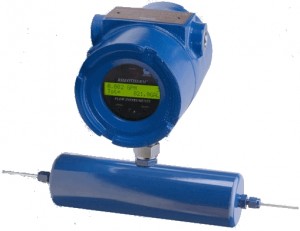
Bionetics’ Rheotherm flow meters and switches include two designs which can be used in hazardous environments using explosion-proof and intrinsic safety techniques. The Explosion-proof Model 210 with integral electronics is approved by FM and cFM for Class I, Division I, Groups B, C & D areas. They are available as TUs or TULs up to ½” and as insertion probes. Rheotherm flow meters and flow switches can also be installed using Bionetics’ proprietary, agency approved intrinsically safe barrier (ISB) to satisfy hazardous environment requirements. For installation flexibility, the remote electronics and the ISB are housed in a NEMA 4 enclosure which can be located in a non-hazardous area up to 200 feet away from the sensor. If the electronics are to be located within the hazardous area, an optional NEMA 7 explosion-proof enclosure can be used.
How often should I perform a calibration check on my flow meters / controllers?
All process instruments experience aging or drift as a result of the conditions of the process in which they are installed. Temperature, electronic component tolerance shift, contamination build up over time (even very slight), plus other factors will all contribute to affecting the accuracy of an instrument. Your instruments should regularly undergo, at a minimum, a calibration check if not a recalibration. But how often?
Because the nature of each application is different (conditions, running time, etc.) a calibration can last for years. Rheotherm instruments do not have specified due dates for calibration. Bionetics suggests Rheotherm instruments be calibrated based on the application conditions and company quality procedures. With no moving parts, measurement orifices, or seals Rheotherm instruments do not require regular calibration in most cases. Each customer must determine when they need to send in an instrument for recalibration. This can easily be done by taking a yearly calibration check and verifying that the instrument output matches.
What options are available for my instrument?
Rheotherm flowmeters are capable of accepting a wide range of input power and outputting flow rate in a wide range of protocols. See our Model Selection Guide for all of our standard available features. Bionetics routinely develops custom instrumentation for challenging process conditions. If you are flowing a high temperature, caustic, corrosive, or otherwise difficult to measure fluid or slurry, contact us today for assistance.
Is there any installation where a Rheotherm is unsuitable?
Yes, Rheotherm instruments rely on the thermal properties of the fluid to make a measurement. If the fluid is a mixture with varying concentrations, the thermal properties will change and the measurement will not be accurate. However, specialized Rheodapt instruments are available to compensate for these changes if the concentration can be measured.
What is the typical lead time and customization capability?
- Lead Time: Every instrument is made to order and precision-calibrated to your specific fluid profile. Standard manufacturing lead time is typically 4 to 6 weeks.
- Customization: We routinely engineer custom instruments for high temperatures, caustic chemicals, and dense slurries. A wide array of input power options, process fittings (flanges, sanitary, tube), and digital/analog communication protocols are available.
Ready to configure your instrument?
Email Us: Download and complete the Flow Application Data Sheet and send it to sales-flow@bionetics.com.
You can visit our Contact Us page.