
Remembering STS-107 and the Zeolite Crystal Growth Experiment
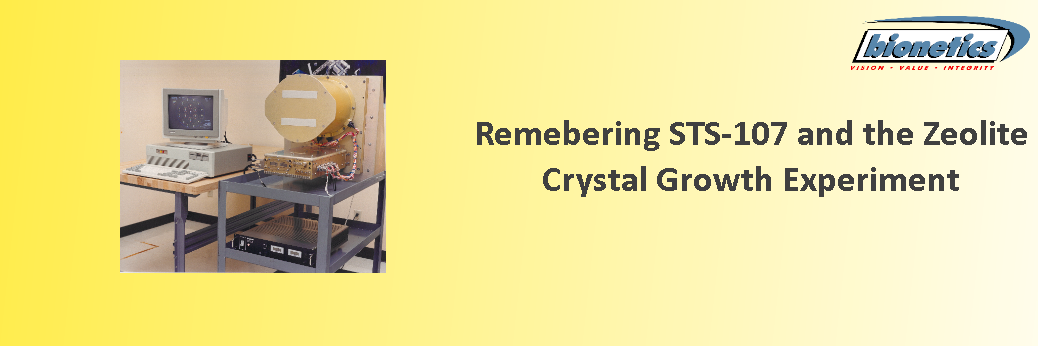
Remembering STS-107 and the Zeolite Crystal Growth Experiment
On February 1, 2003, the Space Shuttle Columbia was lost during re-entry, claiming the lives of its seven astronauts and marking one of the most sobering moments in the history of space exploration. Beyond the profound human tragedy, STS-107 also represented the loss of nearly two decades of scientific effort carried aboard the mission—experiments designed to expand our understanding of materials, physics, and chemistry in the unique environment of microgravity.
Among these experiments was the Zeolite Crystal Growth Experiment (ZCG), a sophisticated materials science investigation aimed at understanding how microgravity affects the formation of zeolite crystals. Developed through a collaboration between the Center for Advanced Microgravity Materials Processing (CAAMP) at Northeastern University, Battelle’s Center for Commercial Development of Space, Worcester Polytechnic Institute, Teledyne Brown Engineering, and Intek, Inc., ZCG represented years of innovation in furnace design, thermal control, software reliability, and space-qualified instrumentation.
Zeolites—microporous crystalline materials widely used in industrial processes such as petroleum refining, gas separation, water treatment, and adsorption—benefit significantly from growth in microgravity. Freed from gravity-driven convection and sedimentation, crystals can grow larger, more uniformly, and with fewer defects, providing insights that are difficult or impossible to obtain on Earth.
This paper recounts the technical evolution of the ZCG experiment, the engineering challenges overcome to make it flight-ready, and the contributions of the engineers and scientists who brought it to life. It also serves as a remembrance of STS-107—not only as a mission lost, but as a testament to the dedication, ingenuity, and collaboration that continue to shape space-based research and advanced instrumentation today.
Explore the history of the STS-107 mission and zeolite crystal growth experiment

About the Author: Matt Charleston
Mr. Charleston is the Director of Engineering at the Bionetics CESG Division. He has been working in the flowmeter industry for 8 years, and in that time has been the author and co-author of several papers on flowmeter and sensor design for cryogenic and aerospace applications. He has developed numerous custom flowmeters to meet the requirements of extreme installation environments and has participated in testing and qualification of these meters.